
Website Conversion Optimization: How to Turn Visitors into Customers
Most of your website's visitors leave without converting. Website conversion optimization is the system that changes it.
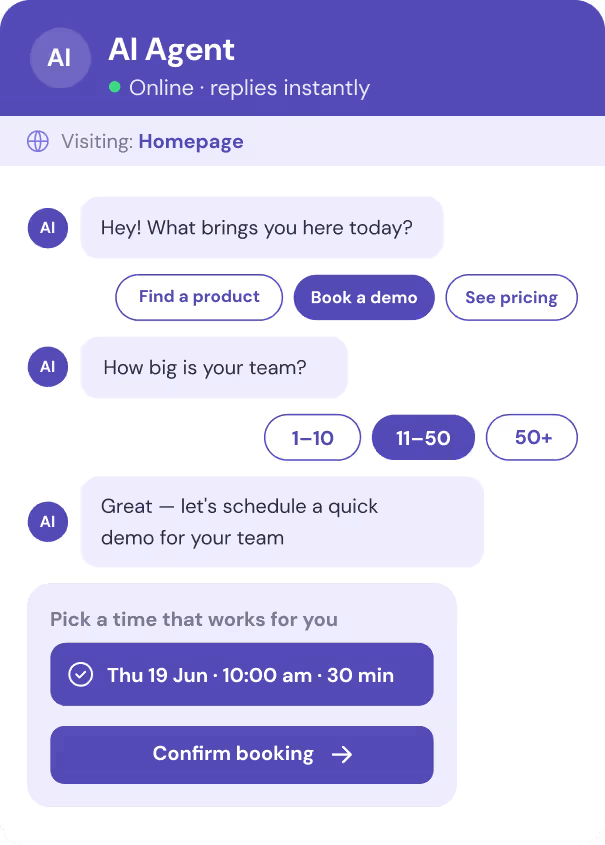
How do you turn website visitors into customers?
This guide covers the full conversion lifecycle: why most pages underperform, how the optimization mechanics differ for B2B and B2C, and how to build an always-on system that captures and converts visitors without manual intervention.
Most websites share the same problem: a static page, a form, and an experience that treats every visitor identically. In B2B, 97% leave without ever identifying themselves. In B2C, cart abandonment sits above 70%. The root cause is the same: no system that responds to each visitor on arrival — qualifying them, routing them, removing friction in real time.
1. What is website conversion optimization?
Website conversion optimization is the systematic process of increasing the percentage of website visitors who take a target action — submitting contact details, booking a meeting, making a purchase, or starting a trial. The core objective is not just capturing more conversions; it's capturing more of the right conversions at a lower cost.
B2B vs B2C conversion: the same system, different objectives
Website conversion optimization applies equally to B2B and B2C — but the definition of a “conversion” and how you optimize for it differs significantly. Understanding the distinction up front prevents you from applying the wrong tactics to the wrong model.
In B2B, a conversion is typically the start of a relationship. A visitor becomes an identifiable lead, enters a sales pipeline, and eventually becomes a customer through a multi-step process measured in days or weeks. The optimization goal is quality over volume. The key metrics are MQL rate, cost per lead (CPL), and lead-to-SQL conversion rate.
In B2C, conversion is often the end of the journey. A visitor makes a purchase, starts a trial, or subscribes. The optimization goal shifts toward reducing friction and maximizing volume. Cart completion rates, checkout abandonment, and revenue per visitor matter more than lead qualification scores. The decision cycle is shorter, the transaction is direct, and personalization — showing the right product or offer to the right visitor — does the work that ICP matching does in B2B.
The lead conversion rate math: why 1% matters
A 1% improvement in visitor-to-lead conversion rate is not a vanity metric. For a website receiving 10,000 monthly visitors, moving from 2% to 3% conversion means 100 additional leads per month — without increasing ad spend. If your average lead-to-opportunity rate is 25% and your average deal size is €10,000, that’s €250,000 in additional pipeline from a single percentage point. For B2C e-commerce, the same math applies to revenue: a 1% lift in purchase conversion on 10,000 monthly visitors at a €50 average order value is €5,000 in additional monthly revenue.
2. Why visitors leave your page without converting
The five structural reasons websites fail to convert
Every website losing conversions at scale is doing so for one of the same five reasons. Here’s what they are — and how to spot which one is yours.
Reason 1: The form-first design assumption. Most websites present a contact form or checkout flow as the primary conversion mechanism. Visitors who aren’t ready to commit simply leave. There is no intermediate conversion path for visitors who are interested but not yet purchase-ready — whether they’re evaluating a B2B vendor or comparing products before buying.
Reason 2: Response time destroys intent — and friction does the same. In B2B, response time is the conversion killer: a visitor who submits a form at 3pm and receives a reply 24 hours later has moved on. In B2C, the equivalent is checkout friction — required account creation before purchase, multi-step checkout flows, unclear shipping costs, or slow page loads at the payment step. B2C cart abandonment averages 70%, and friction at checkout is the primary driver.
Reason 3: One-size-fits-all messaging. A CTO evaluating an enterprise deployment and a marketing manager at a 20-person SaaS company are both “website visitors.” A first-time buyer browsing running shoes and a returning customer looking for an upgrade are both “e-commerce visitors.” Static pages deliver the same message to all of them. None of them feel spoken to directly, and all bounce at higher rates than a visitor who receives a relevant, personalized experience.
Reason 4: No qualification or personalization on arrival. In B2B, without an on-site qualification mechanism, every lead that enters your CRM looks the same: a name, email, and company. Sales teams waste time on unqualified contacts while genuinely ready buyers wait. In B2C, the equivalent is the absence of personalization — without behavioral signals, every visitor gets the same generic experience regardless of what they came to find.
Reason 5: Exit points without recovery. Most pages have a single conversion path. When a visitor doesn’t take that path, they leave — with no recovery mechanism. Exit intent, secondary offers, and progressive profiling are underused precisely because they require conversational capability that static pages can’t provide.
Pro tip: Before optimizing anything, segment your current traffic by source and model. Paid, organic, and direct traffic typically have very different baseline conversion rates — and B2B vs B2C traffic patterns differ further. Optimizing for the average masks where the real opportunity is.
3. What makes a high-converting website
A high-converting website is not defined by design aesthetics. It is defined by the clarity of its conversion paths, the quality of its qualification or personalization signals, and the speed with which it responds to visitor intent. The core structure is consistent across B2B and B2C — but the implementation of each element shifts depending on the conversion model.
The five elements that improve your website conversion rate
Across industries and traffic volumes, the same five structural decisions separate pages that convert from pages that don’t.
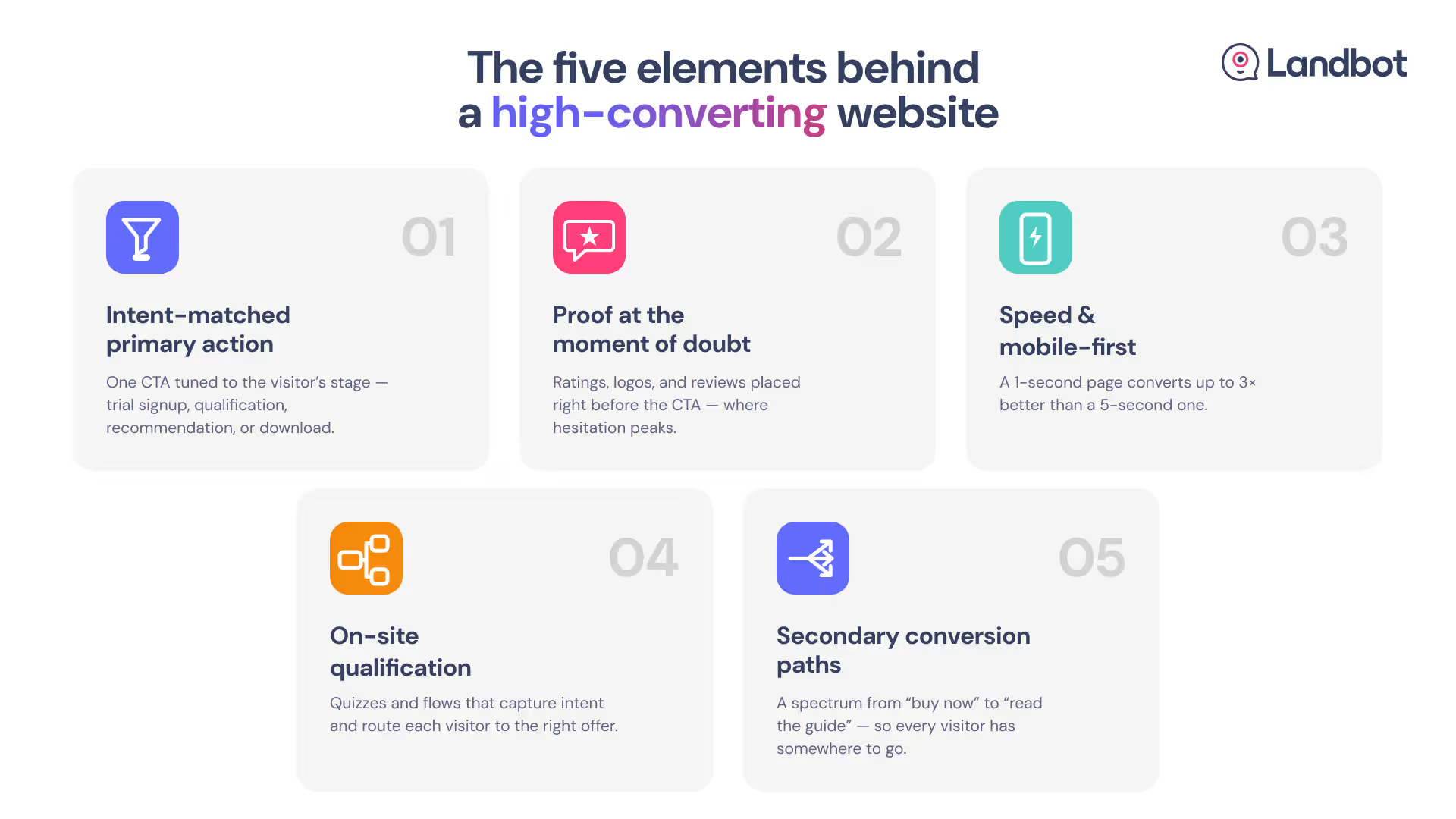
Element 1: A primary conversion action that matches visitor intent. The CTA that converts depends on where the visitor is in the buying journey. In B2B, visitors from branded search are closer to decision; visitors from educational content are in research mode. In B2C, a visitor on a product detail page is closer to purchase than one on a category page. A high-converting website maps conversion actions to intent: a trial signup for the evaluated, a qualification flow for the interested, a product recommendation for the undecided, a piece of content for the aware.
Element 2: Social proof at the moment of doubt. Conversion hesitation typically occurs at the point of commitment — just before the form submit, the meeting booking, or the checkout confirmation. In B2B, G2 ratings, customer logos, case study excerpts, and quantified results placed immediately before the CTA reduce this hesitation. In B2C, star ratings, review volume counts (“4.8/5 from 2,400 reviews”), and user-generated photos do the same job.
Element 3: Speed and mobile-first design. Page speed has a direct impact on whether visitors convert. Bounce probability increases 32% as page load time goes from 1 to 3 seconds — and 40% of visitors abandon sites that take more than 3 seconds to load. For B2B sites specifically, a site loading in 1 second has a conversion rate 3x higher than one loading in 5 seconds. For B2C, the impact is even sharper — a higher share of traffic comes from mobile, where loading delays compound with the friction of a smaller screen.
Element 4: An on-site qualification or personalization mechanism. Static pages capture contact details or trigger purchases. High-converting pages capture context at the moment of engagement. In B2B, this means company size, use case, urgency, and budget — the signals that allow sales to prioritize and personalize follow-up. In B2C, this means product interest, occasion, price range, and preference signals — the inputs for a recommendation engine or a guided discovery flow. A product recommendation quiz, a style selector, or a "what are you shopping for?" flow does the same job as a B2B qualification flow.
Element 5: Clear secondary conversion paths. Not every visitor is ready for the primary CTA. A high-converting website offers a spectrum: the aggressive path (buy now / book a demo), the considered path (start a free trial / save to wishlist), and the educational path (read the guide / use the calculator). In B2C, this also includes email capture flows for visitors who are interested but not ready to purchase today — enabling retargeting and abandonment recovery. Websites that optimize only the aggressive path leave the majority of their audience without a home.
Qualify, route, and convert leads in real time.
Start for free.svg)
Free plan available
No credit card required
Setup in minutes
4. The form vs. conversational conversion case
This is the central argument of website conversion optimization: static forms and passive checkout flows are structurally mismatched to how visitors — both B2B buyers and B2C shoppers — want to engage, and conversational flows close the gap.
Why static forms underperform
Static forms were designed for a world where the only conversion path was a field-and-submit interaction — no immediacy, no personalization, no adaptation. The problems are structural:
- Abandonment at scale. 81% of users abandon forms after starting, and 67% never return due to excessive fields or perceived complexity.
- One-way information flow. The visitor gives data; the company responds later. There is no immediate value exchange, no sense of being heard, and no personalization in the moment.
- No real-time adaptation. A visitor who indicates a €1,000 monthly budget gets the same form path as one with a €100,000 budget. A first-time buyer gets the same checkout experience as a returning customer with a full order history. The form cannot change course.
- No qualification or personalization signal. A completed form tells you a visitor exists, not whether they’re worth pursuing or what they actually need.
How conversational flows convert better
An AI agent, or a structured conversational flow, deployed on your website replaces the static form with a structured, goal-driven conversation. The mechanics differ in three critical ways:
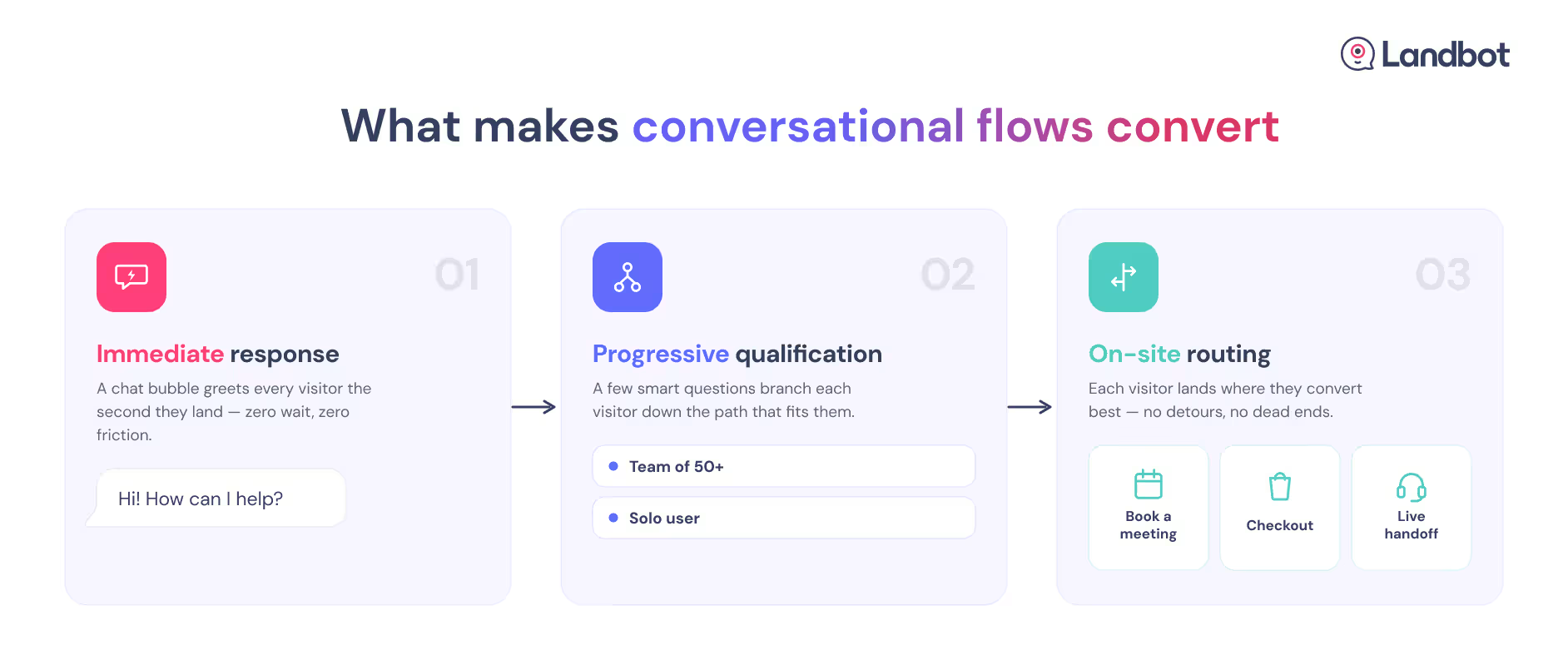
- Immediate response. The visitor receives a response the moment they engage — not when someone checks the inbox or when a retargeting sequence fires. This alone removes one of the strongest friction points in both B2B lead capture and B2C purchasing.
- Progressive qualification. Instead of asking twelve questions in a form, the conversational flow asks questions in sequence, adapting based on previous answers. In B2B, a visitor who indicates they’re evaluating for a team of 50+ sees a different path than one exploring solo. In B2C, a visitor who indicates they’re buying a gift sees a different product path than one shopping for themselves. This produces better outcomes without the friction of a long form.
- On-site routing. When a visitor meets your target criteria — right fit, right intent, right moment — the conversational flow routes them directly to the right next step: a meeting booking, a product recommendation, a direct checkout path, or a live handoff. Visitors who don’t meet those criteria receive relevant content or a re-engagement offer. No manual triage required.
Learn how Lead Laundry achieved 35% higher conversion rates, 50% better lead quality, and more marketing-qualified leads with Landbot.
When to replace a form with an AI agent
The highest-impact replacement opportunities share a common trait: they are pages where visitor intent is high enough that a slow or generic response costs you qualified pipeline or revenue.
Replace a form when:
- Visitor intent varies across the people arriving.
- Context affects what happens next — who you route where, and how you follow up.
- The interaction needs to qualify, personalize, or adapt in real time.
Not every form is worth replacing. A newsletter signup, a webinar registration, a simple file download — where all you need is an email address and intent is already clear — doesn't benefit from a conversational overlay. Adding conversation to a low-friction action creates complexity and can actually reduce completion rates. The rule: replace where context, qualification, or personalization matter. Leave forms where they don't.
Which pages to upgrade first
Once the criteria are met, the question is where to start. Not all pages carry the same weight. These are the page types where conversational flows consistently deliver the highest return — ordered by the size of the opportunity.
Start at the top. A homepage qualification flow and a pricing page upgrade will outperform most other changes in the short term. Work down the list once those are running.
5. How to qualify website visitors automatically
Once a conversational flow is in place, the question is what it actually does with each visitor. Automatic qualification and personalization is the mechanism that decides: who gets fast-tracked to sales or checkout, who enters a nurture or re-engagement sequence, and who is redirected to self-serve content or product discovery — all without human intervention.
The Qualify-Engage-Route framework, applied to website conversion
The Qualify-Engage-Route (QER) framework has a specific application in website conversion optimization. Here, QER is not about building a lead gen agent; it is about designing the on-site intake layer that determines what your website does with each visitor the moment they arrive.
- Qualify: Collect the signals that determine fit or preference. In B2B: company size, industry, role, use case, urgency, budget range. In B2C: category interest, use case, price range, occasion, persona (gift buyer vs. self-purchase, beginner vs. expert). Ask only the questions whose answers change the routing. Every unnecessary question is a conversion drop-off risk.
- Engage: Deliver a response calibrated to fit or preference level. In B2B: high-fit visitors get a direct offer (book a meeting, start a trial, speak to a team member); medium-fit visitors get an educational resource or nurture offer; low-fit visitors get redirected to self-serve content. In B2C: high-intent visitors get a direct path to the most relevant product or offer; undecided visitors get a guided discovery experience; price-sensitive visitors get a comparison view or a lower-commitment option.
- Route: Push each visitor to the right downstream destination automatically. In B2B: CRM with qualification data attached, calendar booking tool, Slack notification to the account owner, or a targeted email sequence. In B2C: product page, curated collection, checkout flow, or email capture for consideration-stage visitors who aren’t ready to buy today. The routing logic runs without involving engineering.
Chatbots vs AI agents vs live chat for visitor qualification
Not all real-time conversation tools are the same — and picking the wrong one is one of the most common reasons qualification breaks down. Here's how the three main options compare.
The right architecture for most teams: AI-first qualification with human escalation for the exceptions.
For more info on how to build the full qualification and routing system behind this framework, read our AI Agent for Lead Generation guide.
Where to route leads based on fit and intent
Once a visitor is qualified or personalized, the routing decision determines whether the conversion happens or is lost. Routing automation covers three scenarios:
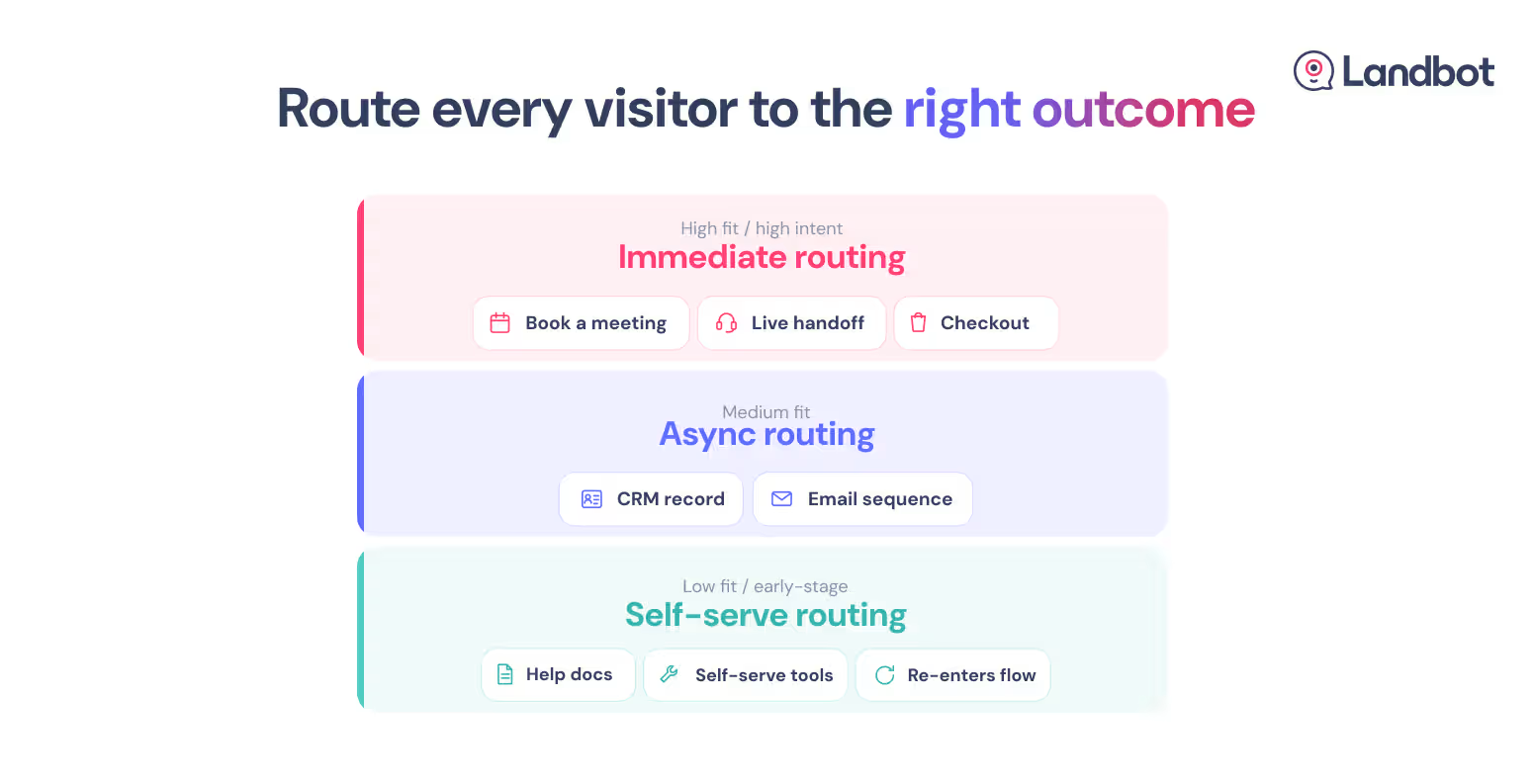
Immediate routing. High-fit visitors (B2B) or high-intent shoppers (B2C) who indicate purchase readiness are directed to a calendar booking, live handoff, or checkout path within the conversation. No form, no wait, no follow-up delay.
Async routing. Medium-fit visitors receive a confirmation and are enrolled in a targeted sequence. The CRM or marketing automation record is created with qualification or preference data attached, and the appropriate follow-up is triggered by territory, product interest, or behavioural signal.
Self-serve routing. Low-fit visitors (B2B) or early-stage browsers (B2C) are directed to documentation, free tools, community resources, or a product discovery experience. They exit the paid conversion flow without consuming sales capacity, and they re-enter the qualification flow when their context changes.
6. Exit intent, progressive profiling, and A/B testing
The Qualify-Engage-Route framework handles the primary conversion path. These three tactics extend conversion optimization to the visitors who don’t take it.
Exit intent
Exit intent mechanisms trigger when a visitor’s cursor movement indicates they are about to leave the page, presenting a secondary offer before they exit — a lead magnet, a free tool, a simplified qualification flow, or a targeted discount.
Exit intent works when the offer matches the page content. A B2B visitor on a pricing page who is about to leave is likely price-sensitive or still evaluating; an offer that provides pricing clarity or a comparison guide has a high relevance score. A B2C visitor about to abandon their cart may respond to a delivery cost clarification, a limited-time offer, or a product alternative. The design constraint is restraint: generic exit intent overlays perform poorly in both B2B and B2C.
Progressive profiling
Progressive profiling collects visitor information in stages across multiple sessions, rather than all at once. A first-time visitor provides their email to access a resource or save their cart. On their second visit, they are asked for their company name (B2B) or their product preferences (B2C). By the fourth visit, you have a complete profile — without ever presenting a twelve-field form.
The identification layer is simple: cookie-based for anonymous visitors, email-based once they’ve converted. The payoff is consistent: staged data collection outperforms full-field forms because visitor trust is earned incrementally, not demanded upfront — in both models.
A/B testing conversion elements
A/B testing in a conversion optimization context is about testing the structural elements that determine whether a visitor converts:
- CTA placement: above the fold vs. mid-page vs. sticky sidebar
- Conversation entry points: proactive chat invitation vs. passive widget vs. embedded flow
- Qualification or personalization question order: urgency first vs. company size first (B2B); occasion first vs. price range first (B2C) — which ordering produces higher completion rates?
- Routing thresholds: does tightening the ICP criteria (B2B) or sharpening the personalization logic (B2C) improve downstream quality enough to offset the volume reduction?
The measurement framework for A/B testing in conversion optimization focuses on qualified outcomes, not raw interaction volume. A test that increases form submissions by 20% but decreases ICP-match rate by 40% or that increases add-to-carts but reduces purchase completions is a negative outcome. Define your success metric as qualified leads or completed purchases before running any test.
Turn website visitors into qualified leads—automatically
Build your first agentFree plan available
No credit card required
Setup in minutes
7. How to measure your website conversion rate
The primary KPIs
Conversion optimization without measurement is iteration without direction. These are the metrics that will tell you whether your conversion system is working — and where to look when it isn’t.
Universal
- Visitor-to-lead conversion rate. (Total leads generated ÷ total website visitors) x 100. This is the headline metric. Track by traffic source — direct, organic, paid, referral — because each has different baselines and different optimization levers. The median B2B website conversion rate is 2.9% across 14 B2B industries — meaning 97 out of every 100 visitors leave without converting.
- Bot completion rate. For AI agent flows: the percentage of visitors who start a conversation and complete it through to the routing outcome. A low completion rate typically signals a conversation design problem.
- Drop-off rate per step. Granular view of where visitors exit a conversational flow. If 40% drop off at the budget question (B2B) or the size selector (B2C), that step is creating friction.
B2B
- Visitor-to-MQL conversion rate. (Marketing-qualified leads ÷ total visitors) x 100. If your visitor-to-lead rate improves but visitor-to-MQL stays flat, you're capturing more contacts but not more qualified ones.
- Lead to sale conversion rate. The downstream metric that determines whether your qualification logic is working. The average Lead → MQL conversion rate is 31% and MQL → SQL is ~35% (40%+ for B2B SaaS).
- Cost per lead (CPL) and cost per MQL. Conversion rate optimization is a cost discipline. Track cost metrics alongside your sales conversion rate to ensure improvements translate into efficiency gains, not just volume.
B2C
- Cart completion rate and checkout abandonment rate. (Completed purchases ÷ cart initiations) x 100, and its inverse. Together they show whether conversions are progressing to the actual transaction — and where in the checkout flow you're losing them.
- Revenue per visitor. Total revenue ÷ total visitors. This measures not just whether visitors convert, but how much value each one generates. A rising conversion rate alongside flat or falling revenue per visitor signals a volume/quality trade-off worth investigating.
- Cost per acquisition (CPA). The bottom-line efficiency metric. Like CPL in B2B, it tells you whether conversion rate improvements are actually reducing what you pay to acquire a customer.
B2B lead conversion rate benchmarks
Knowing your absolute conversion rate matters less than knowing where you stand relative to your sector. The figures below are visitor-to-lead rates for full B2B websites (not landing pages)
B2C conversion benchmarks
B2C conversion rates vary significantly by category — and the gap between sectors is wider than most teams expect. The overall e-commerce average at 1.8–3.3%, but price point, purchase frequency, and decision complexity all pull that number in different directions. Always benchmark against your specific vertical, not the overall average.
If you are operating at or near the high-performer benchmark for your industry or sector, conversion rate optimization alone will have diminishing returns. At that point, the focus shifts to quality optimization — ensuring the conversions you capture are the ones most likely to generate revenue or pipeline.
For a deeper look at the structural reasons lead quality breaks down — not just conversion volume — check out our Six structural lead generation problems of SaaS guide.
8. FAQs
FAQs about website conversion optimization
Website conversion rate optimization (CRO) is the systematic process of increasing the percentage of website visitors who complete a target action — submitting contact details, booking a meeting, making a purchase, or starting a trial. It operates on existing traffic: improving conversion by 1–2% from current traffic is typically cheaper than buying equivalent additional traffic through paid channels.
The goal differs. B2B optimization targets qualified lead capture — visitors become identifiable contacts that enter a sales pipeline, and the core metrics are MQL rate and cost per lead. B2C optimization targets direct transactions or sign-ups — visitors complete a purchase or subscription, and the core metrics are cart conversion rate, revenue per visitor, and cost per acquisition. Conversational flows, exit intent, and A/B testing apply to both; what you qualify for and how you route visitors depends on the model you’re optimizing.
The median B2B website conversion rate is 2.9%. However, this varies dramatically by industry: legal services converts at 7.4%, financial services at 5.0%, while B2B SaaS sits at just 1.1% — among the lowest of any B2B vertical. Always benchmark against your specific vertical, not a cross-industry mean.
It depends on the sector and what counts as a conversion. E-commerce purchase rates typically run 2–3%. High-consideration B2C categories (insurance, finance) run 2.5–5.2% — close to B2B benchmarks because the decision cycle is similarly extended. Always benchmark against your specific sector and conversion type, not a cross-vertical average.
Lead generation focuses on driving visitors to your website — through paid, organic, or referral channels. Conversion rate optimization focuses on what happens when they arrive: the percentage of those visitors who take a desired action. CRO operates on existing traffic; lead generation expands that traffic base. Optimizing only one produces diminishing returns.
An AI agent replaces static forms with a real-time, goal-driven conversation. It qualifies visitors on arrival or personalizes their experience, adapts its questions based on previous answers, and routes visitors based on fit or intent — without human intervention. The result is a higher conversion rate (more visitors convert because the experience is lower-friction) and a higher quality rate (conversions that reach the CRM or checkout carry richer data, not just contact details).
Initial results from conversational flow deployment are typically visible within two to four weeks of going live. The first metric to move is visitor-to-conversion rate; quality rate takes longer to stabilize because it requires enough downstream data to be statistically meaningful. A/B testing programs typically require 4–8 weeks per experiment to reach statistical significance at moderate traffic volumes.
Exit intent detects when a visitor is about to leave the page and triggers a secondary conversion offer before they exit. In B2B, exit intent works best when the offer is specific to the page content — a pricing comparison tool on a pricing page, a use case guide on a product feature page. In B2C, a cart abandonment offer, a delivery cost clarifier, or a product alternative can recover visitors who would otherwise leave. Generic offers perform poorly in both contexts. Specificity to the visitor’s context is what drives engagement.
Not for the majority of conversion optimization initiatives. Conversational flow deployment, A/B testing setup, and CRM or e-commerce integration configuration can all be completed by a marketing or operations manager using a no-code platform. Landbot’s AI agent platform is designed for this use case: a full-stack marketer who configures qualification logic, integrates with HubSpot, Salesforce, or Shopify, and iterates in production — without a developer in the loop.
The standard conversion optimization stack includes: an AI agent platform (for conversational lead capture, qualification, and personalization), an A/B testing tool (for structural experimentation), a heat mapping and session recording tool (for identifying drop-off points), and a CRM or e-commerce platform (for measuring lead quality or purchase conversion downstream).
It depends on the complexity of your qualification or personalization logic. A rule-based conversational flow handles structured intake well — if your qualification follows a fixed decision tree and your ICP criteria or product recommendation logic are straightforward, a structured flow can capture and route effectively. An AI agent becomes the better choice when your logic needs to adapt dynamically: different paths based on company size, use case, urgency, product category, or any combination of signals that a fixed tree can’t handle cleanly.
Turn more website visitors into qualified leads
Qualify visitors, personalize their journey, and route them to the right next step automatically—without code.
Free plan available
No credit card required
Setup in minutes